Polski
  Español
  Italiano
  Deutsch

Are There Animals That Never Sleep
 12 October 2026
  kama
kama A cat curled up asleep, a dog dozing on the sofa, or a bird resting on a branch – these are familiar sights. In the animal kingdom, however, sleep does not always look the way we might expect. Some species rest with one eye open, while others can fall asleep during flight. There are even organisms that enter a sleep-like state despite having no brain.
Does this mean there are also animals that never sleep? The answer requires caution. Sleep or sleep-like states have been described in very different groups of animals, but not every species has been thoroughly studied. Just because we do not see an animal sleeping does not mean it can manage entirely without sleep.
What Does It Actually Mean for an Animal to Sleep?
In humans, sleep is associated with closed eyes, a relaxed body, and reduced awareness of the surroundings. Yet this picture does not fit every inhabitant of our planet. How can we recognise sleep in a jellyfish or a fruit fly?
Scientists examine several features. They check whether an animal periodically reduces its activity, whether it becomes less responsive to stimuli during that time, and whether it can be returned to wakefulness relatively quickly. They also investigate what happens when rest is disrupted. An increased need for sleep after it has been restricted is an important indication that the observed state is more than a random pause in movement.
Stillness alone is therefore not enough to conclude that an animal is asleep. It may remain motionless while carefully watching its surroundings. Conversely, movement does not always rule out sleep – as studies of birds in flight demonstrate.
Dolphins — Resting One Half of the Brain at a Time
Dolphins are one of the most remarkable examples of how varied sleep can be. They live in water but breathe air. They therefore need to reach the surface regularly while retaining the ability to orient themselves in their surroundings.
Unihemispheric sleep helps them do this. In this state, one hemisphere of the brain displays activity characteristic of slow-wave sleep, while the other remains more alert. This allows a dolphin to rest while continuing to swim and monitor its surroundings.
This mechanism is also associated with keeping one eye open – the eye connected to the wakeful hemisphere. A similar arrangement occurs in some birds.
This does not mean that dolphins never sleep. Their sleep simply does not resemble our nightly rest. It is an adaptation that allows them to reconcile the need for sleep with the demands of life in the water.
Is It Possible to Sleep While Flying?
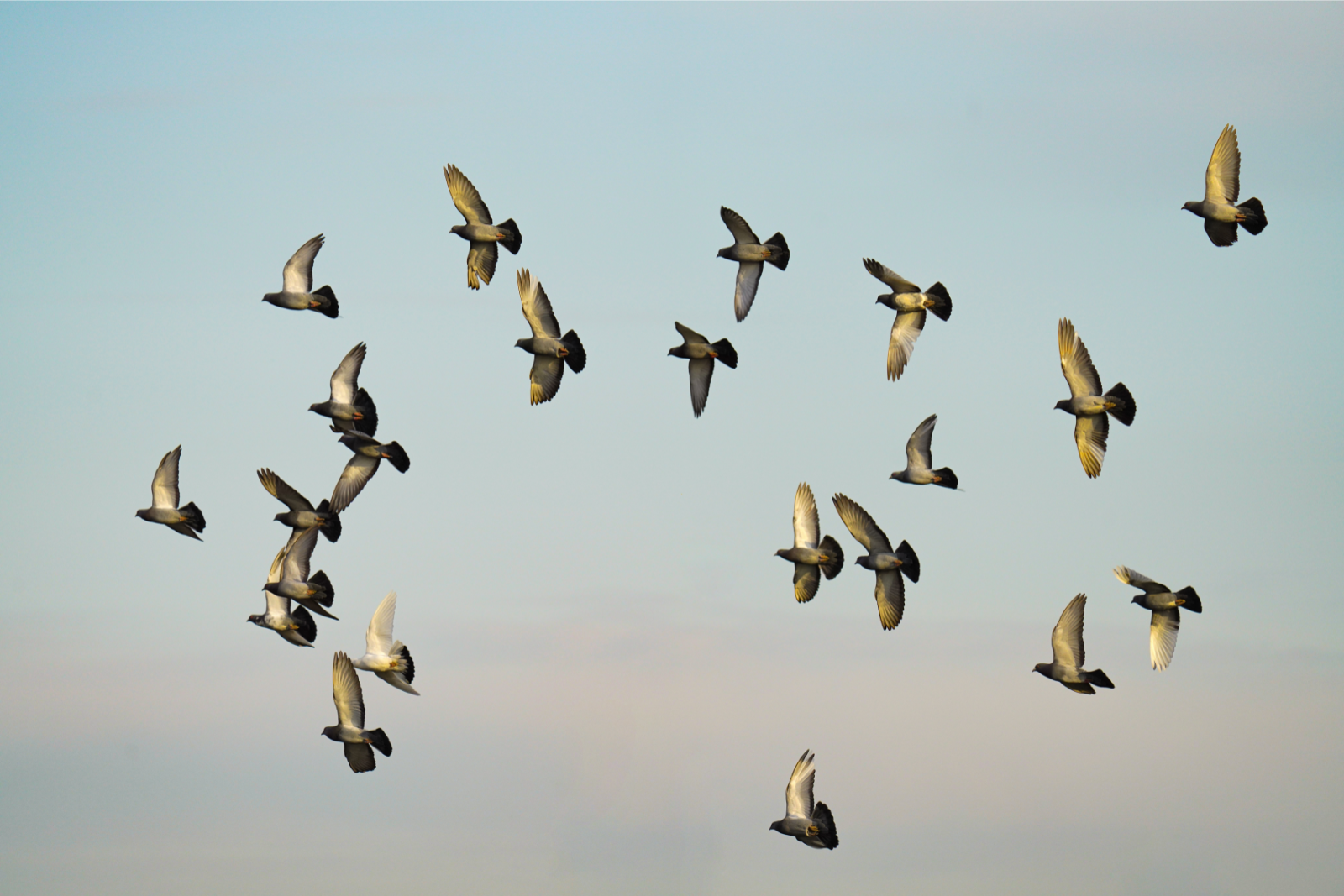
Birds that fly for days at a time have long fascinated researchers. If an animal does not land for an extended period, when does it find time to sleep? Does it fall asleep in the air, or temporarily reduce its rest?
Direct evidence came from studies of frigatebirds in which their brain activity was recorded during flight. The results showed that these birds really can sleep in the air. Researchers observed both sleep in one hemisphere and brief periods of sleep in both hemispheres simultaneously.
Even more surprising was the amount of sleep. The frigatebirds studied slept for an average of around 42 minutes a day during flight, far less than on land. Their airborne sleep was brief and divided into short episodes.
These findings should not automatically be applied to all birds that undertake long journeys. The fact that a species spends a long time in the air is not, by itself, proof that it sleeps in flight. Nevertheless, frigatebirds show that even such a demanding activity can leave room for brief moments of rest.
Fruit Flies Need Sleep Too
We tend to associate fruit flies with constant movement around ripe fruit. Yet these tiny insects also have periods of rest that meet important criteria for sleep.
Researchers have observed that fruit flies choose a resting place, remain still for extended periods, and become less responsive to stimuli. When experiments prevented them from resting, they subsequently increased the amount of rest they took. This indicates biological regulation of their need for sleep.
Such a small animal has therefore become a valuable research model. Observing fruit flies helps scientists understand the mechanisms controlling sleep and wakefulness, including the role of genes.
Their example reminds us that an animal’s size does not reveal how complex the processes within its body may be. Even an insect that is easy to overlook has its own rhythm of activity and rest.
Sleep Without a Brain — The Remarkable Case of Jellyfish
One of the most surprising discoveries concerns jellyfish of the genus Cassiopea. These animals have no centralised brain. They do, however, possess a nerve net that allows them to respond to their surroundings and coordinate their activity.
A study published in 2017 showed that these jellyfish reduce the frequency of their body pulsations at night. In this state, they also respond more slowly to stimuli. When their nighttime rest was disrupted, researchers observed reduced activity and responsiveness the following day, consistent with a need to make up for lost rest.
This behaviour met the criteria for a sleep-like state. The discovery supports the hypothesis that the evolutionary origins of sleep predate the emergence of a centralised nervous system.
Sleep, or a sleep-like state, therefore does not require a brain built like a human one. This is an important clue for researchers trying to understand why sleep emerged during evolution and what its original functions might have been.
Little Sleep Does Not Mean No Sleep
Stories about animals that “never sleep” often arise from the difficulty of observing their rest. If sleep is brief, occurs at unusual times, or does not require complete stillness, it can easily go unnoticed.
It is also important to distinguish between three situations: an animal sleeps very little, temporarily reduces its sleep, or never sleeps throughout its entire life. These are different claims that require different evidence.
Nor can we assume that every species will make up for restricted sleep in exactly the same way humans do. Research reveals considerable diversity in behaviour, and in certain animals under particular conditions, the typical increase in sleep following a long period of wakefulness has not been observed.
It would therefore be an oversimplification to say that all animals sleep in the same way and must always make up for every lost hour.
Is There an Animal That Truly Never Sleeps?
There is insufficient evidence to present any particular species as an indisputable example of an animal that goes through its entire life without any form of sleep. At the same time, we have not studied all animals thoroughly enough to confidently rule out every exception.
The most honest answer is therefore: sleep is remarkably widespread in the animal kingdom, but its universality and boundaries remain subjects of research. Recognising it can be especially difficult in organisms whose behaviour and nervous systems differ greatly from our own.
A dolphin resting one hemisphere of its brain, a frigatebird falling asleep above the ocean, a motionless fruit fly, and a jellyfish pulsing more slowly all show how carefully we should judge animals through the lens of our own experience. Their rest may be almost invisible to humans, yet still form an important part of their lives.
When looking at an animal that seems constantly active, it is worth asking: does it really never sleep, or have we simply not yet learned to recognise its sleep?